

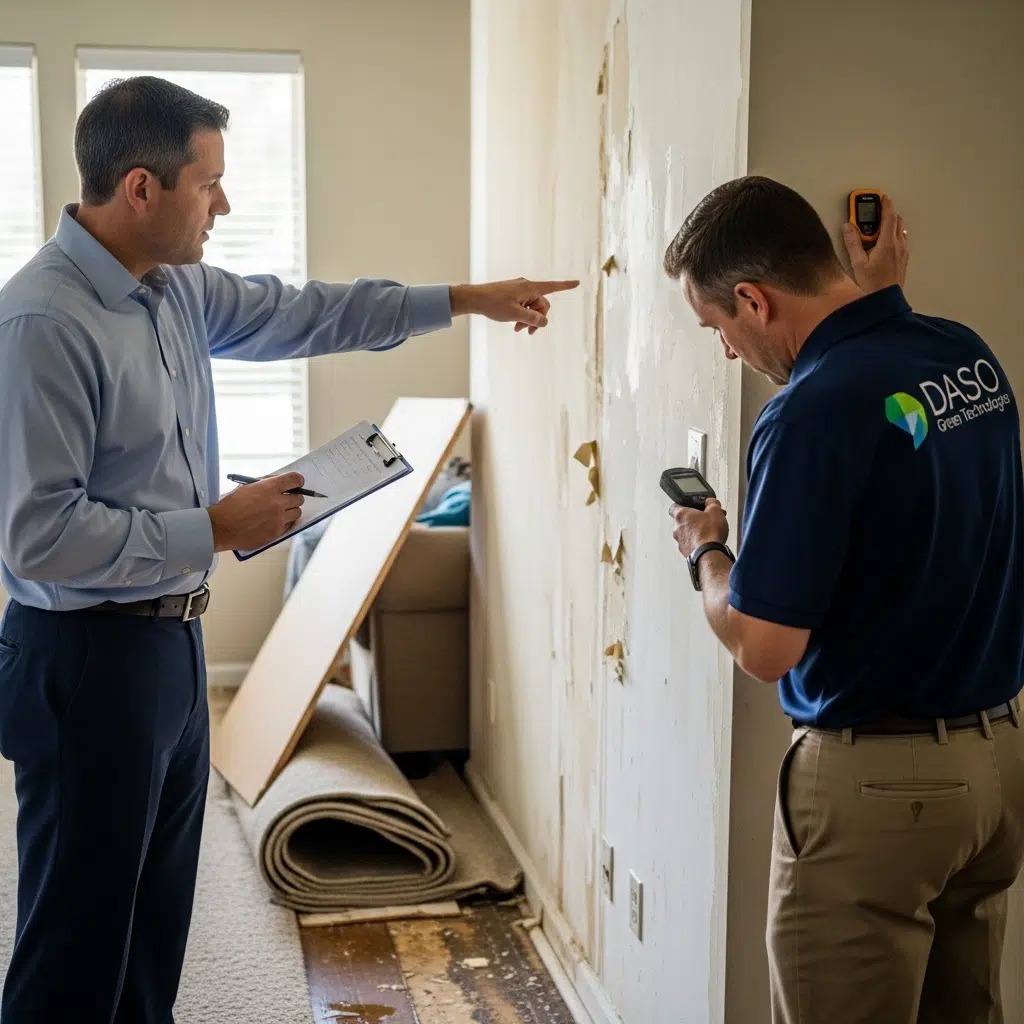
Navigating Property Damage: How Restoration Companies Work With Insurance Adjusters
When disaster strikes a home or business, the immediate aftermath is often characterized by confusion and urgency. Whether the cause is a burst pipe, severe storm damage, or fire suppression fallout, property owners must contend with two distinct challenges: the physical restoration of the structure and the complex logistics of the insurance claim. Understanding how professional restoration companies interact with insurance adjusters is vital for ensuring a seamless recovery process.
At DASO Green Technologies, we recognize that effective communication with insurance carriers is as critical as the technical remediation itself. Serving New York City, Long Island, and Westchester, our team provides the technical expertise and detailed documentation required to substantiate claims and expedite the restoration process.
The Intersection of Restoration and Insurance
Insurance adjusters are tasked with determining the extent of coverage based on the policyholder’s contract. However, adjusters are rarely technical experts in environmental remediation or structural drying. They rely heavily on the objective data provided by professional restoration firms to make informed decisions.
This is where insurance claim assistance becomes a core component of professional service. A certified restoration company does not determine coverage, but it provides the undeniable proof of damage required for the claim to proceed. Without professional intervention, homeowners risk underestimating the scope of damage, leading to insufficient settlements and unresolved structural issues.
The Importance of Mitigation vs Repair
A common point of confusion for property owners is the distinction between mitigation vs repair. Insurance policies typically require the policyholder to take immediate steps to prevent further damage—this is mitigation. Failure to mitigate, such as leaving standing water to stagnate, can lead to claim denial.
Mitigation involves emergency water extraction, stabilization, and containment. Repair involves the reconstruction that follows. DASO Green Technologies focuses heavily on the mitigation phase, utilizing industrial-grade equipment to stabilize the environment immediately. By clearly delineating these phases in our reports, we help adjusters understand that immediate costs were necessary to prevent much larger secondary damages, such as mold growth or structural rot.
Recommended Industry Resource
Maintaining a controlled environment is essential for preventing secondary moisture damage, particularly in high-humidity areas like basements or during the interim period before professional crews arrive. For property managers and business owners looking to manage humidity levels effectively, we recommend exploring high-capacity solutions.
The ALORAIR Commercial Dehumidifier is a robust unit designed to manage moisture in large spaces. While this equipment serves as an excellent tool for environmental maintenance and early intervention, it is important to note that consumer-grade or even semi-commercial equipment is not a substitute for professional insurance water damage restoration services when significant flooding or contamination occurs.
Documentation: The Key to a Successful Claim
The most valuable asset during a claim is rigorous water damage documentation. Adjusters require proof of the damage source, the moisture content of materials, and the necessity of the work performed. DASO Green Technologies utilizes advanced moisture mapping, thermal imaging, and industry-standard software (such as Xactimate) to align our reporting with insurance requirements.
Our process ensures that every step is justified and recorded:
- Assessment: A comprehensive inspection to identify the source and extent of damage.
- Containment: Isolating the affected area to prevent cross-contamination of mold spores or particulates.
- Remediation: The physical removal of standing water, damaged materials, and contaminants.
- Cleaning: Sanitizing the area using EPA-registered antimicrobials to ensure hygiene and safety.
- Restoration: Preparing the site for final reconstruction.
- Post-Service Verification: Testing to prove that the property has been returned to a safe, dry standard.
Why Professional Intervention is Critical
Attempting to handle water damage or environmental hazards without professional assistance is dangerous. Hidden moisture can lead to microbial growth within 24 to 48 hours, posing severe health risks including respiratory issues and allergic reactions. Furthermore, DIY repairs often mask the problem rather than solving it, leading to long-term structural decay that insurance may refuse to cover later.
Professional technicians are trained to identify risks that are invisible to the naked eye. By hiring a certified firm, you ensure compliance with health regulations and secure the technical data necessary for your insurance carrier to process your claim fairly.
Trust DASO Green Technologies for Rapid Response
When property integrity and health are at stake, time is of the essence. DASO Green Technologies offers rapid-response services across NYC, Long Island, and Westchester, ensuring that mitigation begins before secondary damage sets in. We work alongside your insurance adjuster, providing the professional expertise and transparency needed to navigate the claims process smoothly.
If you suspect water damage, mold, or environmental hazards, do not wait. Contact us immediately for a professional assessment.
Call DASO Green Technologies today: 929-472-3899